.png)
The Marie-Séraphique, a slave-trading ship from Nantes in the 18th century (EN, FR)
The Marie-Séraphique, a slave-trading ship from Nantes in the 18th century
Bernard MICHON
The trade of enslaved African people required the use of multipurpose ships that became floating prisons between the African coasts and the European colonies. Despite the importance of this type of trade to the West, few representations of those ships exist today. Those of the from Nantes, dating from the 1770s, allow us to understand the layout and functioning of a slave-trading ship.
Context: representing the trade of enslaved African people in the 18th century
Printing and circulating images of slave-trading ships was of major importance to the men and women who had won the abolitionist cause at the end of the 18th century. Their aim was to arouse the indignation of European populations, in particular by showing the horrific conditions in which enslaved people were deported, in very cramped, uncomfortable positions. The most famous example is that of Liverpool ship, the , an illustration of which was discovered and disseminated in 1788 by Thomas Clarkson (1760-1846), one of the founders of the in London (ill. 3, plan and profile of the ). No less than 454 captives are represented, a figure that conforms to the guidelines of a British law, the, which regulated for the first time, the living conditions onboard slavers, and limited the maximum number of people to be embarked, based on the ship’s tonnage. At the time however, thewas known to have transported up to 609 captives on one crossing.
Nevertheless, certain representations of trading ships done at this same time did not necessarily aim to denounce this trade in human beings or its abolition. This was especially the case in maritime and port circles whose income came largely from the trade of enslaved people and, more broadly, from colonial trade based on exchanges with overseas territories where plantations had been established. One may therefore wonder about the purpose of the drawings representing the , a trading ship from Nantes that made four expeditions to the African coast between 1769 and 1773, under the command of Jean-Baptiste Fautrel Gaugy, deporting 1,344 captives to the French West Indies. What was the intention behind such a commission and who were the recipients of these images, now housed in the Nantes History Museum - Castle of the Dukes of Brittany? Was it to celebrate the positive results of these four expeditions? Or was it to pay tribute to the wife of the ship's owner, Jacques Barthélémy Gruel (c. 1731-1787), named Marie-Anne Séraphique? Or was it a gift from the sailors to the shipowner to celebrate the end of operations? It is impossible to say, especially since the precise dates of the drawings are unknown. Another theory that appeals to historians is to put forward the commercial purpose of this approach: the drawings were done to attract investors to participate in the financing of expeditions. In any case, it is unlikely that the view of the steerage of the , overcrowded with captives, would have troubled the conscience of either the authors or recipients of these drawings.

Archive: two representations of the , a slave-trading ship from Nantes (undated 1770s)
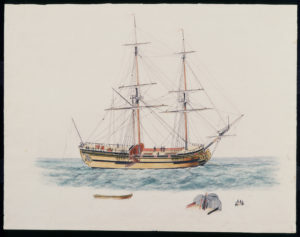
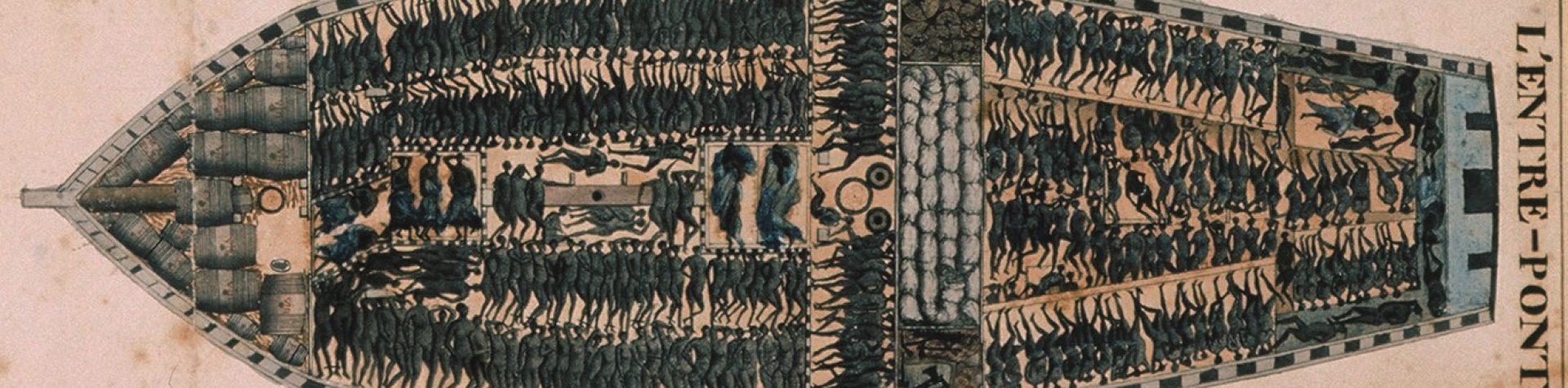
The first drawing, by Jean-René Lhermitte (ill. 1 Marie-Séraphique), shows various cross-sections of the , a profile view of the ship off a coast, and various information about journeys, cargoes, and sales prices during the expeditions carried out between 1769 and 1773. The second drawing (ill. 2, ), whose author is anonymous, represents the same ship, this time in 1772-1773, at the time of an auction of captives off Cap-Français (in Saint-Domingue). Today, very few representations of trading ships exist, and the drawings of the e are therefore a significant archive that help us understand the functioning of such ships in the 18th century.

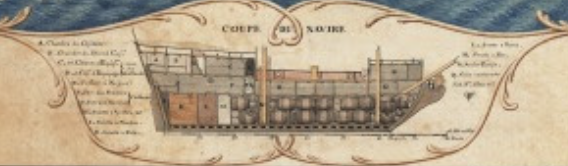
The had a keel length of 63 feet (20.41m hull length) and a beam length of 23 feet (7.45m width), a draught of 11 feet (3.56m), and a carrying capacity of 150 tons. It transported between 302 and 361 African captives over the course of its four voyages, and had a crew of between 38 and 41 men. The is an example of an average-sized trading vessel, although it is difficult to determine a standard. While there was a tendency to increase the size of vessels throughout the 18th century, with the use of large carriers of 400, 500 or even more tons, modest-sized ships of less than 100 tons were still commonplace throughout the period.
As shown in the two drawings above, the “Section of the ship” (ill. 2) and the “Steerage” (ill. 1), the search for profit led the organizers of the expeditions to optimize space in order to cram in as many people as possible. The volume of the hold was divided according to two principles: the separation between the zones containing the reserves of water, food, and equipment, and those housing the captives. There was also a separation between the men, always more numerous, placed in the centre and at the front of the ship, and the women, pregnant or not, accompanied by children, confined to the back. The usable surface area was designed to accommodate four individuals per square metre, who were crammed together, naked, and chained in pairs to further reduce their mobility.
In theory, the captives were only grouped together in steerage at night or during bad weather. To limit the physiological and psychological risks, it was essential to allow the captives out into the open air: this was normally the case from 9am to 5pm, between the two mealtimes. In addition to cleaning operations in steerage, which were entrusted to captives supervised by sailors, the prisoners alternated manual work sessions with physical exercises that sometimes went as far as dancing, according to the recommendations in the slave-trading manuals or the instructions given to the captains by the shipowners. However, when the captives were kept in steerage, their health degenerated at a rapid and dangerous rate. While the was not affected by epidemics or revolts; the mortality rate of the captives, from 2% to 6% of the workforce depending on the campaign, was lower than the average established at 15% for transatlantic trade.
It is also important to insist on the duration of the crossing of the Atlantic Ocean. The “middle passage” generally lasted around two months, a time frame that was typical throughout the 18th century. If the duration naturally depended on weather conditions, it also depended on the African point of departure. From Senegal, a crossing of three to four weeks was not unusual. From the coast of Angola, as in the case of the Marie-Séraphique, which traded in Loango, it took 40 to 60 days. This crossing, of uncertain duration, required sufficient fresh water supplies to ensure the survival of the crew and captives. For the Marie-Séraphique, 335 barrels of water are mentioned in the ship’s log, that is to say approximately 62,500 litres, for the purposes of drinking, cooking, and washing. We can therefore understand the importance of the so-called “refreshment stopovers” that allowed traders to show off the captives in a more presentable light in order to sell them to the colonists. This type of sale can be seen in the drawing titled Vue de Cap-Francais (ill. 2), the main port of the colony of Saint-Domingue, located near lucrative sugar plantations. Transactions took place onboard the ship where the captives were sold in lots. Payment for the captives was made either in colonial goods or in money, and payments were often spread over several years.

In this drawing, we can see a fan-shaped wooden palisade that cut the trading ship in two. This partition, which opened via one or two doors, was pierced through with loopholes allowing the use of firearms to quell any rebellions by the captives. The partition was also lined with sharp iron blades to prevent its climbing by potential rebels. It protected the whole of the rear forecastle of the ship, and provided a proper defensive space housing the captain's and officers' quarters, as well as the ammunition stores.
Translated by Emma Lingwood
Further Information:
3D video reconstruction of The Marie-Seraphique (Source : SlaveVoyages database) - (ENG) https://www.slavevoyages.org/voyage/ship#3dmodel/0/en/

Table of Contents
About the author
Bernard Michon is a lecturer in modern history at Nantes University and a member of the Centre de recherche en histoire internationale et atlantique (CRHIA-UR 1163). His work focuses on the history of French and European trading ports in the 17th and 18th centuries. He is also interested in the history of the Atlantic trade of enslaved peoples. His recent research has led him to study the history of coffee, from production to consumption.
Bibliography
Acerra, Martine, « Le navire négrier aux xviie et xviiie siècles », Cahiers des Anneaux de la Mémoire, n° 10, Bernard Michon (dir.), , Nantes, 2007, p. 22-32.
Boudriot, Jean, Aurore, Paris, Ancre, 1984, 144 p.
Guillet, Bertrand, , Nantes, Musée d’histoire de Nantes/Éditions MeMo, 2009, 187 p.
Rediker, Marcus, , New York, Viking Penguin, 2007 ; , traduit de l’anglais par Aurélien Blanchard, Paris, Seuil, 2013, 549 p.
Saupin, Guy, « La violence sur les navires négriers dans la phase de décollage de la traite nantaise (1697-1743) », in Mickaël Augeron et Mathias Tranchant (dir.), , Rennes, Presses universitaires de Rennes, 2004, p. 201-220.
SEE MORE